
TENTH GRADE
CURRICULUM
In tenth grade, you’ll build connections, detect processes, and trace logic across subjects to develop a clearer picture of how the world works.
Below are examples of classes we’ve offered recently:
Science
-
This course takes an overview approach to general chemistry with a focus on acid-base chemistry. We begin by investigating the properties of water as an introduction to chemical structure, electronegativity, polarity, and solubility. We then study acids, bases, salts, and the reactions they partake in, using stoichiometry to demonstrate how matter is conserved as it changes form. Coursework is largely lab-based; students gain hands-on practice with techniques essential to the high school chemistry laboratory.
-
Mechanics builds on the student’s understanding of the physical world to bring a greater understanding of motion. Through lived experiences and practical experiments, the students begin to uncover fundamental properties of mechanics for themselves. In this class, students study velocity, acceleration, gravity, inertia, and energy. They will use these concepts and applied mathematics to understand complex interplays of motion such as collisions and the ways gravity moves celestial objects.
-
In this block, students study ecology at different levels of organization. We begin with populations, expand to communities, and then consider the biosphere as a whole. At all levels, we explore how the biotic and abiotic components of an ecosystem coexist interdependently, generating both emergent capabilities and tensions. We investigate human impacts on climate and consider climate justice perspectives as we look ahead into the possible futures of our shared planet. This project-based course contains a significant experiential component; students design an experiment, collect data in the field on a multi-day camping trip, learn how to analyze and interpret their data, and synthesize their findings into a formal lab report.
Mathematics
-
This block brings about an introduction to the concepts of sine, cosine, and tangent that will be used extensively in their math education. By grounding these concepts in the triangle and the unit circle, the students begin to develop a deep understanding. Then, this block puts that understanding into practice by having the students use trigonometry to create an accurate topological map of an area.
-
This year focuses on in-depth understanding of the key geometric shapes of triangles and circles. By practicing with these shapes and variations of them in both 2 and 3-dimensions, the students gain an understanding and appreciation of area, surface area, and volume, as well as understanding why calculating these things matter. Students learn the core tenets of trigonometry, gaining knowledge of sine, cosine, and tangent and the various ways these ideas can be applied to real world situations. They also study the conic sections: parabolas, circles, hyperbolas, and ellipses.
Humanities
-
This main lesson explores a variety of poetic forms, and students have the opportunity to experience poetry as a poet, a reader, and a teacher. Students work with form and content, and write everything from haikus to sonnets and sestinas. Each student creates a personal poetry anthology that is handwritten and bound into a booklet. Guest speakers from different poetic traditions bring poetry alive as a contemporary art form.
-
Science fiction is a term that describes literature set in a reality shaped by advancements of science and technology. In projecting past the everyday, works of science fiction force conversation about the possibilities in the present moment. Science fiction asks questions such as: What is time? What characteristics of humankind do we deem so essential that they will exist in 10,000 years? How would a world without gender be ordered? If a language could hijack someone’s mind, what would its grammar make them do? In asking questions like these, science fiction opens up new ways of thinking about the “real world” and how we live in it.
-
The tenth grade curriculum focuses on texts that explore dramatic irony, tension, and even horror, including Dr. Jekyll and Mr. Hyde by Robert Louis Stevenson, The Crucible by Arthur Miller, and Mexican Gothic by Silvio Moreno Garcia. Literature discussion includes an emphasis on tone, style, and authorial intention. The tenth grade writing curriculum builds on sentence and paragraph level skills as students learn how to develop cogent arguments over multiple paragraphs, sequencing details and using transition words, phrases and sentences to develop the relationships between ideas Students also produce short pieces on subjects from nature. Spelling, vocabulary, grammar and reading fluency at the high school level are taught systematically and practiced regularly throughout the year. Word study includes an in-depth study of morphology and etymology, building up vocabulary through work with meaningful word parts.
History
-
This course is an interdisciplinary study of the United States, focusing on the West, Midwest, South, and Northeast in turn. Students learn about the history, geography, politics, culture, and literature of each area of the United States, with a focus on how regional events impacted the development of the country as a whole. For each main lesson, students complete a large paper, presentation, or artistic inquiry driven by a topic of their choice, with increasing expectations for complexity of research and presentation in later grades. Students will take a multi-day trip to an important cultural region of the United States in one of their American Studies blocks.
-
In this course, students will study a few of the diverse cultures that existed in this time period –specifically we will study the cultures that left behind some sort of durable writing that we can interpret today. Students will learn about the daily life and philosophical underpinnings of ancient cultures, paying particular attention to the way power relations were shaped by stories. Students will also think critically about ancient history today, and how the stories we tell about the past have a big impact on how we live in the present.
-
Throughout history, leaders, thinkers, pacifists, tyrants, artists, and activists have imagined and fought for a better society—a ‘good’ society. In this three week course, students will explore the scholarship, literature, and philosophy that reflect this most human of journeys: the quest for a better world. The course will challenge students to think about the ways in which resources are utilized to create a just and fulfilling society. Through a blend of reading and discussion, role playing, collaborative projects, and reflective exercises, students will explore the practical implications of their ideals.
Languages
-
Spanish classes build on the foundation laid in Middle School, introducing complex tenses and grammatical structures, and deepening the study of cultures throughout the Spanish-speaking diaspora.
Arts
-
In this course, students return to a form they thought they knew—watercolor—and experience it in an entirely new way. Students learn how to build up and control watercolor through the use of layers, or veils. Projects include a color wheel, and a final major study: an interpretation of an Impressionist masterpiece rendered in watercolor.
-
In this block, students explore various techniques and types of weaving. Students are introduced to weaving with a small card-weaving project. Other weaving projects include belts woven on inkle looms and individual projects such as scarves, placemats and shawls woven on floor or table looms. As each weaving is finished, the students are taught how to remove the weaving from the loom as well as different methods for finishing the ends.
-
In this block, the students learn basic cooking skills and how to apply them. Skills taught are how to properly use kitchen knives for cutting various foods, how to measure ingredients, the components of recipes and how to prep various ingredients for recipes. Two classes each week are spent prepping for the school lunch program and also any prep needed for community service donations. On days that we have extra time, we prepare various dishes to eat together in class. The block culminates with a meal prepared and donated to a local charity.
-
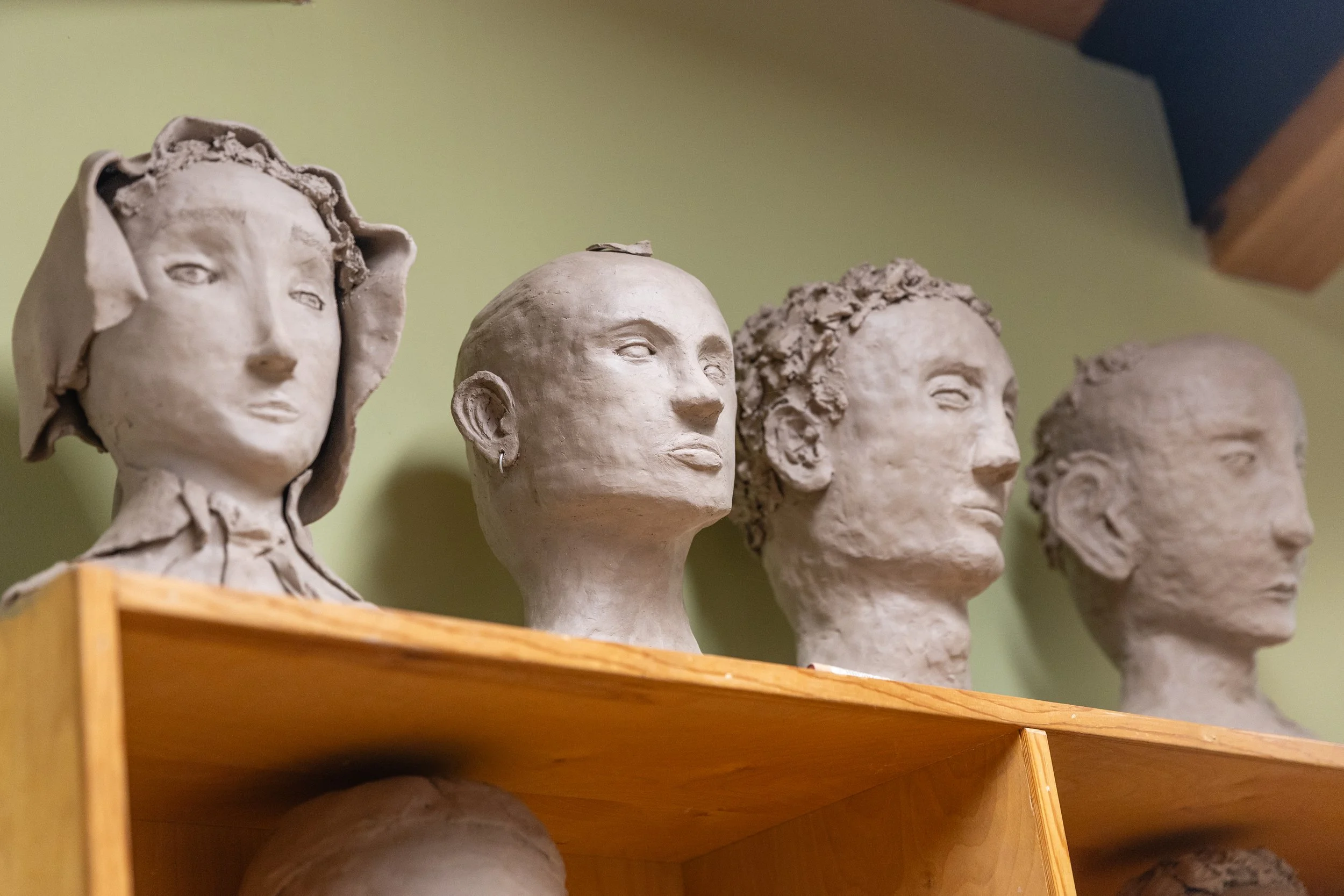
In this block, the students explore the various hand-building techniques for forming clay into sculptural and practical forms. The students first work from observation in sculpting natural objects out of clay. After a few weeks of this clay work, the students begin making hand-built vessels by building up the form with coils. Students also create vessels with slab work and explore surface design. The objects the students decide to keep are bisque-fired and/or glazed and fired.
Music & Theater
-
Students in grades nine through twelve can participate in weekly instrumental music classes. Ensembles perform at school festivals, community events, and the formal Spring Benefit, a culminating performance of their year’s work. These performances give students the opportunity to share their hard work and experience a sense of service to others. Working as an ensemble supports the students’ understanding of how individual parts come together to achieve a collective accomplishment.
-
Students experience choral music from many cultures, times, and places, and in different musical genres. Through weekly classes, they improve their vocal technique, learning to sing together with a sense of commitment and responsibility to themselves and one another.
-
In high school, students explore the historical and social significance of culturally important plays. Class play blocks, typically during sophomore and senior years, are an opportunity to study masters like Shakespeare, Shaw, Lorca, Wilde, and Williams, along with more contemporary playwrights, and to deeply explore the challenging social themes that these writers raise. Students explore vocal techniques, acting, and scenic design through the performances, and all students work both on and off stage. In addition to studying the texts and performance techniques, students learn technical design by taking up lighting, set and costume design, and stage management. Some students also take on the extra challenge of directing roles.
Physical Education
-
Our daily movement program is in many ways preparation for our larger Outdoor Education days and expedition trips. Each school day starts with 30 minutes of activity to “warm up” for academics. Depending on the season, the classes may walk, bike, or snowshoe, or play invigorating outdoor games.
-
Weekly classes feature seasonal sports like hiking, cross-country skiing, and basketball, as well as strength- and coordination-building exercises, spatial dynamics, yoga and team-building games.
-
Each of our outdoor trips starts by building and tending the sense of community within the group, teaches sequenced skills, and culminates in an experience in which you will practice what you have learned—often without the help of your teachers and guides. Wilderness survival skills are taught during our outdoor education classes and then directly applied by students working together on their outdoor education trips. We find that class communities are always strengthened by the outdoor experience that carries back into day-to-day life.
Natural history and environmental science lessons are taught in the field, and you will learn to discern, observe and draw conclusions coming out of your physical senses. This experiential learning is central to our curriculum.