
ELEVENTH GRADE
CURRICULUM
By eleventh grade, you’ll build on observation skills you developed in previous grades. The curriculum weaves through the study of self, from a focus on the birth of individualism in the Renaissance to the study of the developing human being in embryology.
Below are examples of classes we’ve offered recently:
Science
-
This block begins with an understanding of electrical fields, magnetism, and their interrelationship through electromagnetic induction via various experiments. Building off these ideas, students study how electromagnetism is used practically in our daily lives through understanding ideas like voltage, current, and resistance, as well as applications of our knowledge through the building of circuits with breadboards. These experiences allow students to better understand modern technology such as their cell phones, computers, speakers, and motors.
-
This course introduces students to organic or carbon-based chemistry. We explore how atomic structure influences molecular structure, which then influences reactivity. Topics include molecular geometry, nomenclature, functional groups, separation techniques, and synthesis reactions, contextualized in naturally-occurring organic processes and relevant synthetic applications. Practical coursework includes a combination of lab work and modeling; students learn techniques essential to the high school organic chemistry laboratory and use a variety of materials to visualize molecular structures.
-
This block develops the student’s understanding of genetics and evolution through the study of embryology and deeper cell biology. Through the understanding of genetic code and sexual reproduction, students can explore the way life on Earth developed, in part through studying the way embryos develop.
Mathematics
-
Projective geometry is a modern expansion of classical Euclidean geometry. Whereas, Euclidean geometry, which our students learn in tenth grade, explores the nature of shapes on a "local" level, projective geometry explores the infinite projections of those shapes. This field has important influences on modern math disciplines, has interesting echoes in calculus, and supports several sciences critical to the modern world.
We study Projective Geometry because it provides an opportunity for students to move beyond conventional spatial imagination toward a more purely abstract but rational way of coming to know a truth. We achieve this by making specialized drawings and logical proofs, then considering what would happen under certain un-drawable or un-visualizable conditions – namely the behavior of geometric objects "at" infinity. Also, we studied the properties of infinity and its cardinalities.
-
This class focuses primarily on functions, gaining an understanding of how they are used, their notation, and the many versions of them, such as rational, exponential, and trigonometric functions. This knowledge is tied directly into the visualization of functions, helping students understand graphing and the transformation of functions. In addition to this, students continue to expand on some of their statistical knowledge, and they learn how to work with imaginary numbers.
Humanities
-
In eleventh grade, students study Dante's Inferno as it aligns with their own journey toward self-discovery and moral understanding. This medieval Italian epic poem, with its powerful themes of redemption, justice, and the soul's journey, calls on each reader to consider their own journey. Through Dante's work, students explore complex ethical questions through writing and discussion.
-
The eleventh grade literature curriculum makes a leap into the conceptual as students are introduced to work of several key theorists whose ideas have informed a modern and postmodern understanding of literature. Students read excerpts from the work of Freud, Marx, Foucault, and others, then apply these ideas to classic texts such as Siddartha and Death of a Salesman through original interpretation. Students also complete a lengthy essay analyzing a film of their choice from a theoretical perspective, and argumentative essays on topics of their choice.
History
-
This course is a study of the changes in world civilizations, culture, and thought from the fall of empires in late antiquity through the medieval period. Our goal is to gain a greater understanding of the Europeans' medieval mindset, in contrast to the cosmopolitan view of the Islamic golden age. A focus will be to understand how both of these contributed to the evolution of the modern world.
-
This block focuses on the basic principles of economics, and touches on macroeconomics, microeconomics, capitalism, communism, manufacturing and investment. We study household economy, the role of corporations, productivity, profit and loss, supply and demand, and the foundations and functions of money, using readings from Adam Smith, Karl Marx and others as our foundation. Students will gain an understanding of the way the economy functions on and individual and a corporate level, and the effect of economic forces on the world today, particularly in light of the current economic situation.
-
This course serves as an experiential tour through music around the world, with a particular focus on the history of world music, and the role it played in how people connected with the world around them. Through this study, students have the opportunity to explore their own personal connection to various musical forms. By building a musical vocabulary and developing listening skills, students try to hear and experience music as people of different epochs would have heard it, while simultaneously developing an awareness of the context in which people hear and experience music in our time. Students participate in class discussions, complete listening assignments, attend live musical performances, and each student presents a project based on a topic that interests them that relates to course material.
-
This course provides an in-depth introduction to the foundational ideas and beliefs of several major world religions, including Hinduism, Buddhism, Judaism, Christianity and Islam. As students explore the core tenets and practices of each faith, they are encouraged to identify and reflect on the universal elements shared across different traditions. The course particularly examines how diverse cultures have engaged with fundamental existential questions: Where are we? Why are we here? What is our purpose? In addition to group presentations on various religions, they compose a spiritual autobiography and engage in practical application of their learning by organizing a universal seasonal winter festival for the high school.
-
This course is an interdisciplinary study of the United States, focusing on the West, Midwest, South, and Northeast in turn. Students learn about the history, geography, politics, culture, and literature of each area of the United States, with a focus on how regional events impacted the development of the country as a whole. For each main lesson, students complete a large paper, presentation, or artistic inquiry driven by a topic of their choice, with increasing expectations for complexity of research and presentation in later grades. Students will take a multi-day trip to an important cultural region of the United States in one of their American Studies blocks.
Languages
-
Spanish classes build on the foundation laid in Middle School, introducing complex tenses and grammatical structures, and deepening the study of cultures throughout the Spanish-speaking diaspora.
Arts
-
In this continuation of the painting curriculum, students are introduced to acrylic paints, and work especially with their qualities of transparency and opacity. Years of working with color and light allow students to grasp the potential of this new medium. The final project is a self-designed work, and a focus of the class is discussion and critique in a workshop environment. We practice offering thoughts about our own and others’ work with compassion and objectivity.
-
This block covers the process of sculpting busts in clay working directly with observation of the human form. The students begin the block with preliminary exercises to develop their observational skills. Next is the process of building up the bases for their sculptures by rolling the clay into coils and stacking them up into hollow vertical forms. Each student then manipulates the clay to resemble the shape of the head and neck and begins to add features. After all the features are added, the top of the head is closed, the hair is added and final touches are made. The block ends with a critique utilizing the practice of offering thoughts about our own and others’ work with compassion and objectivity.
-
The evolution of the book parallels the development of human thought. Students are introduced to the materials, tools and techniques of bookmaking; the precise skills and logic of the process are especially suited to the eleventh grader’s developed thinking and manual dexterity. Book forms include sewn pamphlets, hinged albums, and a formally bound book. In their final project students are encouraged to explore other historical, cultural, or inventive book structures and boxes.
Music
-
Students in grades nine through twelve can participate in weekly instrumental music classes. Ensembles perform at school festivals, community events, and the formal Spring Benefit, a culminating performance of their year’s work. These performances give students the opportunity to share their hard work and experience a sense of service to others. Working as an ensemble supports the students’ understanding of how individual parts come together to achieve a collective accomplishment.
-
Students experience choral music from many cultures, times, and places, and in different musical genres. Through weekly classes, they improve their vocal technique, learning to sing together with a sense of commitment and responsibility to themselves and one another.
Physical Education
-
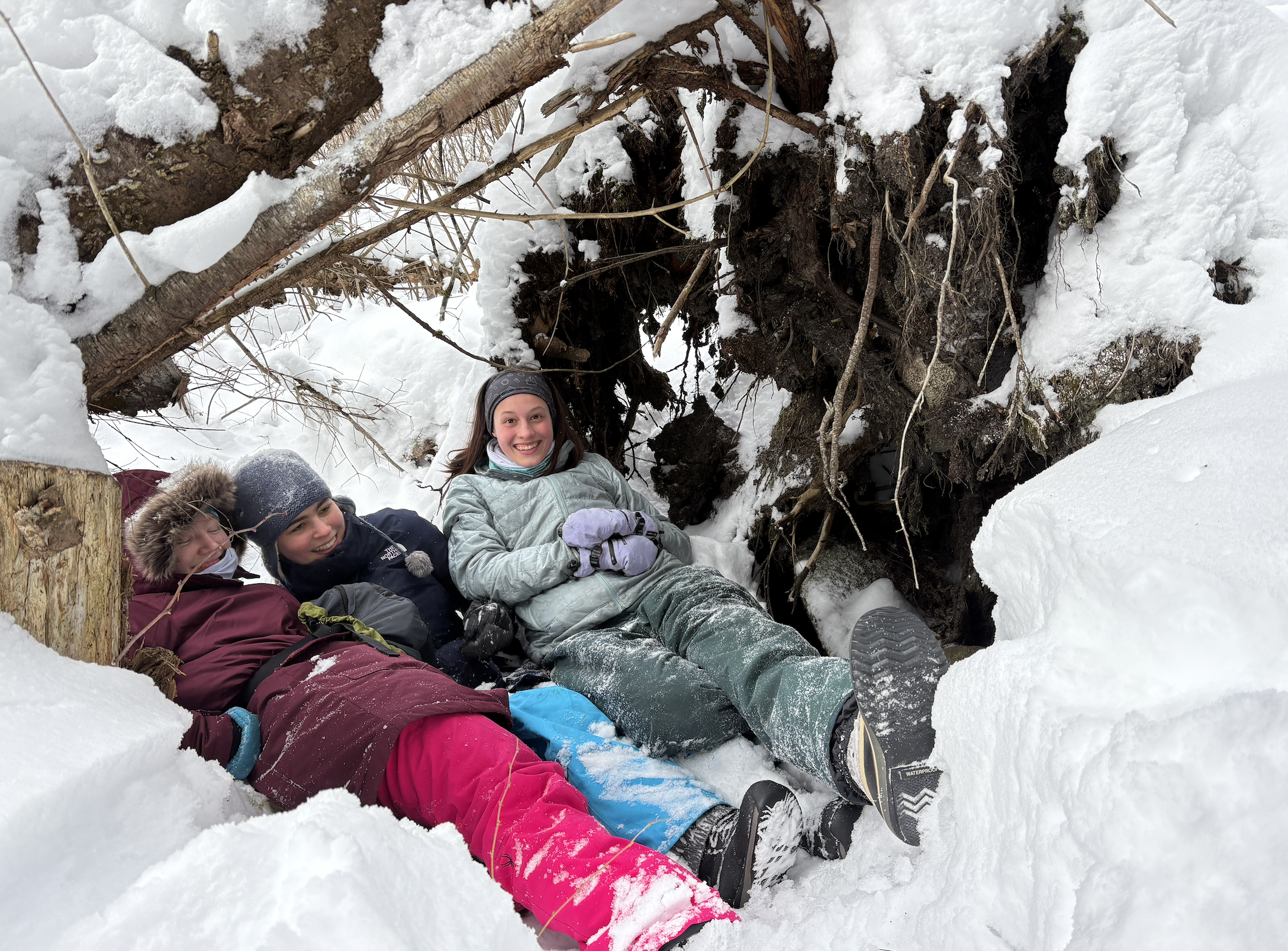
Our daily movement program is in many ways preparation for our larger Outdoor Education days and expedition trips. Each school day starts with 30 minutes of activity to “warm up” for academics. Depending on the season, the classes may walk, bike, or snowshoe, or play invigorating outdoor games.
-
Weekly classes feature seasonal sports like hiking, cross-country skiing, and basketball, as well as strength- and coordination-building exercises, spatial dynamics, yoga and team-building games.
-
Each of our outdoor trips starts by building and tending the sense of community within the group, teaches sequenced skills, and culminates in an experience in which you will practice what you have learned—often without the help of your teachers and guides. Wilderness survival skills are taught during our outdoor education classes and then directly applied by students working together on their outdoor education trips. We find that class communities are always strengthened by the outdoor experience that carries back into day-to-day life.
Natural history and environmental science lessons are taught in the field, and you will learn to discern, observe and draw conclusions coming out of your physical senses. This experiential learning is central to our curriculum.