
TWELFTH GRADE
CURRICULUM
By senior year, you’re ready to ask big questions about who you are and what you’re meant to do in the world. Able to think both analytically and creatively, you’ll step back and seek a global perspective in modern philosophy, literature, and science.
Below are examples of classes we’ve offered recently:

Science
-
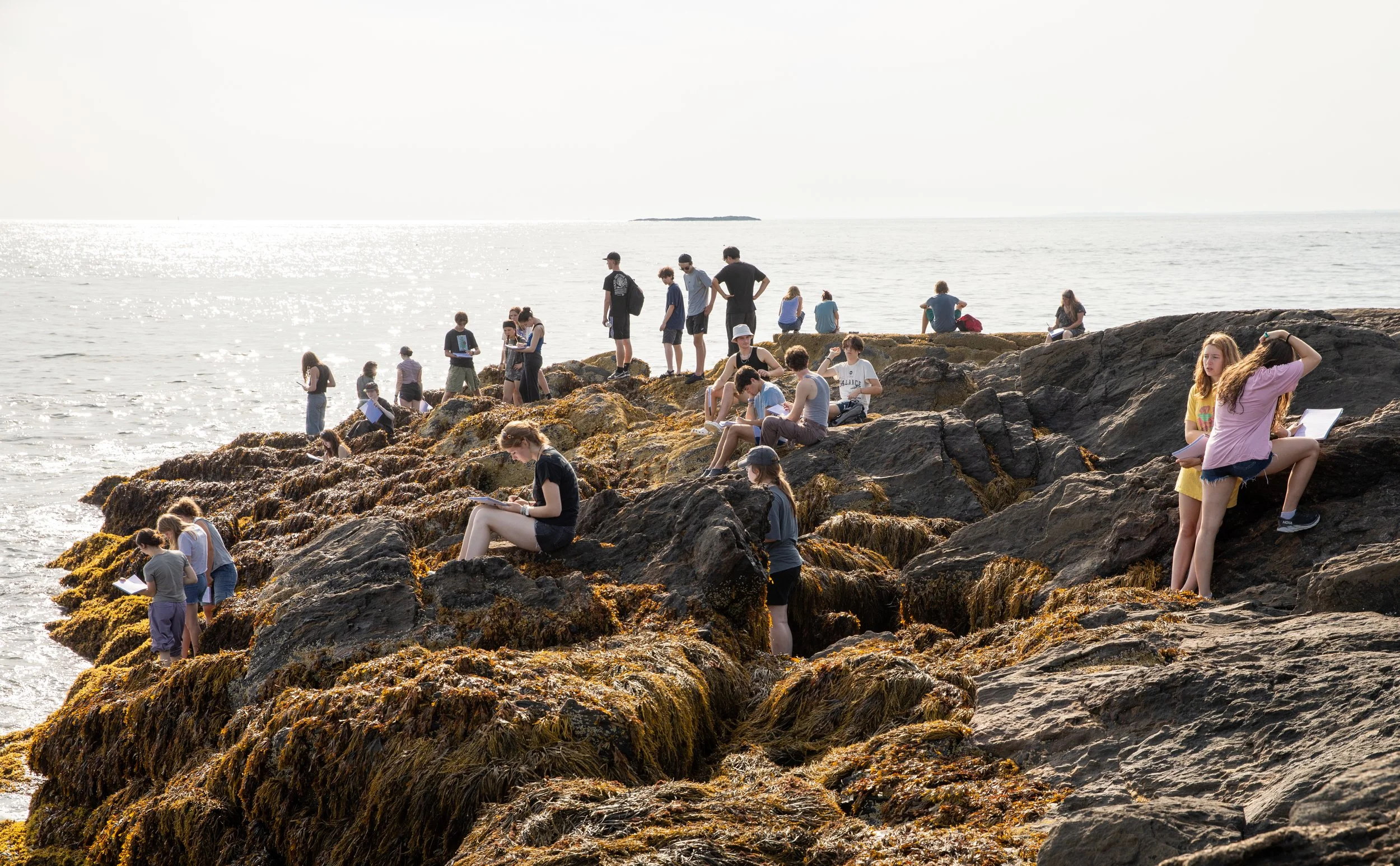
This course guides students on a journey through major groups of the animal kingdom. Students compare and contrast the characteristics of invertebrate phyla and vertebrate classes and explore the evolutionary processes underlying their similarities and differences. The course begins with consideration of what it means to be an animal and concludes with a discussion of the human being, reflecting on humanity’s place within kingdom Animalia and what this means for our relationships with nonhuman animals. This block features a camping field trip to Hermit Island in Maine, where students join around 100 other Waldorf high school 12th graders for a weeklong field-based course on marine invertebrate zoology.
-
This course serves as a general overview of topics in biochemistry, introduced in the context of plant and animal physiology. Building on prior work in organic chemistry, students explore how organisms use biochemical macromolecules for homeostasis, communication, and defense. We learn about carbohydrates, lipids, proteins, and nucleic acids through their roles in physiological systems across the kingdoms of life. Practical coursework includes a combination of lab work and modeling; students learn techniques essential to the high school biology laboratory and use a variety of materials to simulate complex physiological systems.
-
This course explores light as both perceptual experience and physical phenomenon. Topics include color theory, reflection and refraction, interference and diffraction, and visual perception. We conclude with an introduction to modern quantum physical interpretations of light, studying the foundational historical experiments that steered classical optics towards quantum perspectives of wave-particle duality and quantization. Building on prior understanding of light as an electromagnetic wave, we can then consider how viewing light as a particle helps us conceptualize phenomena like fluorescence. Coursework is lab-based; students use mirrors, prisms, lenses, spectroscopes, lamps, and lasers to investigate optical phenomena.
Mathematics
-
Statistics is used to summarize large amounts of information, as well as to make predictions about the future from the present. This important field is increasingly used in our world. Through this main lesson block, students will gain a better understanding of how statistics can be used to draw conclusions, as well as learn the methodologies required to generate meaningful and accurate data sets.
-
This class will explore the applications of calculus to various practical engineering, biological, economic, and geometric problems. The course is intended to prepare a student for the possibility of entering a math-intensive college track such as engineering, pre-medicine, physics, or mathematics. It explores derivatives and integrals, allowing the students to understand the fundamental theorem of calculus.
Humanities
-
This block considers the nature of the human being, child development, and the implications these have on education. In connection with this, we invite students to reflect on their educational experiences from kindergarten through high school. Readings on human development include excerpts from the Transcendentalists and other philosophers as they consider what it means to be human. We also visit the various branches of our school to make first-hand observations of children and teaching.
-
In the first 6-8 weeks of twelfth grade, students return to the fundamentals of writing a good sentence as they focus on the art of the personal essay. Students read and discuss personal essays from authors including James Baldwin, Annie Dillard, Joan Didion, and Virginia Woolf. Students will brainstorm topics for their Common Application essay, then draft, workshop,
and revise at least one essay.From November through April, students engage with a variety of texts aimed at developing skills for cultural analysis, including visual images, fiction, non-fiction, film, and documentary. Themes will include the construction of race, gender, and power through representation. Students will compose short responses to texts. Time is also provided in class to work on the major components of the senior project paper.
History
-
This course is an interdisciplinary study of the United States, focusing on the West, Midwest, South, and Northeast in turn. Students learn about the history, geography, politics, culture, and literature of each area of the United States, with a focus on how regional events impacted the development of the country as a whole. For each main lesson, students complete a large paper, presentation, or artistic inquiry driven by a topic of their choice, with increasing expectations for complexity of research and presentation in later grades. Students will take a multi-day trip to an important cultural region of the United States in one of their American Studies blocks.
-
This course examines the evolution of human consciousness, culture and values by studying the physical structures human beings have built over the course of history. By synthesizing art, history, engineering, and philosophy, the course provides a culmination to students’ aesthetic experience in the Waldorf curriculum. Course lectures, readings, observations, drawing, and discussion ground students in a range of the earliest known structures on earth, the major technological and aesthetic advancements that in turn inspired others, and, ultimately, take up a personal project to dive into a topic of interest that will be shared with the class. In studying the context and purpose of a variety of buildings across time, students realize each individual’s potential to shape our collective future through thoughtful understanding of our architectural inheritance and look forward to building on the lessons of the past.
-
Though the “modern era” arguably began at the end of the middle ages, the term is most often used to describe the events of the late modern period and contemporary historical moment. In this course, we’ll focus on the global transformation that occurred in the 19th and 20th centuries, also known as the “late modern” period and contemporary history. The events of this period –from the Civil War to the fall of the Berlin Wall in 1989– were instrumental in forming the historical circumstances of our present moment. Students will read primary source documents from this period and produce a main lesson book focused on the big ideas of the modern era.
Languages
-
Spanish classes build on the foundation laid in Middle School, introducing complex tenses and grammatical structures, and deepening the study of cultures throughout the Spanish-speaking diaspora.
Arts
-
This culminating class in the fine arts curriculum involves working from life using a mirror to create an oil self-portrait, utilizing the work of various artists to influence and inform the piece. This is a major work of art that develops from a series of sketches to finished oil painting over 12 or more weeks, and is presented in each student’s graduation display as a representation of his or her work at our high school.
-
In this block students explore the design of clothing from both a practical and a fashion perspective and bring their knowledge and personal expression together to design and create an article of clothing. Skills taught include drafting a pattern from an article of clothing, altering the pattern, calculating the fabric needed, planning out the procedure for sewing and sewing the article of clothing.
Music & Theater
-
Students in grades nine through twelve can participate in weekly instrumental music classes. Ensembles perform at school festivals, community events, and the formal Spring Benefit, a culminating performance of their year’s work. These performances give students the opportunity to share their hard work and experience a sense of service to others. Working as an ensemble supports the students’ understanding of how individual parts come together to achieve a collective accomplishment.
-
Students experience choral music from many cultures, times, and places, and in different musical genres. Through weekly classes, they improve their vocal technique, learning to sing together with a sense of commitment and responsibility to themselves and one another.
-
In high school, students explore the historical and social significance of culturally important plays. Class play blocks, typically during sophomore and senior years, are an opportunity to study masters like Shakespeare, Shaw, Lorca, Wilde, and Williams, along with more contemporary playwrights, and to deeply explore the challenging social themes that these writers raise. Students explore vocal techniques, acting, and scenic design through the performances, and all students work both on and off stage. In addition to studying the texts and performance techniques, students learn technical design by taking up lighting, set and costume design, and stage management. Some students also take on the extra challenge of directing roles.
Physical Education
-
Our daily movement program is in many ways preparation for our larger Outdoor Education days and expedition trips. Each school day starts with 30 minutes of activity to “warm up” for academics. Depending on the season, the classes may walk, bike, or snowshoe, or play invigorating outdoor games.
-
Weekly classes feature seasonal sports like hiking, cross-country skiing, and basketball, as well as strength- and coordination-building exercises, spatial dynamics, yoga and team-building games.
-
Each of our outdoor trips starts by building and tending the sense of community within the group, teaches sequenced skills, and culminates in an experience in which you will practice what you have learned—often without the help of your teachers and guides. Wilderness survival skills are taught during our outdoor education classes and then directly applied by students working together on their outdoor education trips. We find that class communities are always strengthened by the outdoor experience that carries back into day-to-day life.
Natural history and environmental science lessons are taught in the field, and you will learn to discern, observe and draw conclusions coming out of your physical senses. This experiential learning is central to our curriculum.
Senior
Projects
-
The Senior Project is a capstone experience to a student’s Waldorf education. Beginning at the end of eleventh grade, students start to do preliminary research in an area of personal interest. Seniors work with the Senior Project Committee, in class and out of class, to craft the topic into a thesis statement or question that connects to the wider world. Along the way, students use their toolkit of skills in organization, documentation, and research. Throughout the academic year, seniors individually work with a Senior Project Mentor, complete appropriate community service that is relevant to their developed topic, journal regularly, write a well-composed paper, and, finally, deliver a well-organized presentation to the community about their area of study.
Senior Project Presentations
Seniors have explored a wide variety of subjects for their senior projects. Past topics have included:
What role does sustainable entrepreneurship play in the VT economy?
Eating Disorders and Body Image: What are they and how are they influenced by social constructs and social media?
Understanding the importance of community in the opioid crisis
How do team and individual sports affect a child’s development?
How can we improve the quality of life and job opportunities for people living with serious mental illness?
How can using refillable water bottles help reduce plastic waste?
Over the summer between junior and senior year students keep a research journal and bibliography, and refine their topic. By fall they have identified a community mentor with whom they will work closely over the year. Each senior project includes a research component, artistic or practical component, and community service. Each student integrates eight hours of community service into his or her project.
As students spend 100+ hours with their subject, they encounter and overcome many dead-ends and problems. They learn to persevere through difficulties, find new resources, and examine the subject from multiple perspectives. In the spring of their twelfth grade year each senior presents an extensive written report and some other product (ranging from a novel to a hand-built telescope) that represents his or her best work. The project is presented to a committee of teachers and community members and before the entire school. Students learn valuable public speaking skills as they present and explain their work before a group.
For many of our students, the senior project is the most challenging, memorable, and valuable experience they have at LCWS.